

The way a seed becomes a pine, or an acorn becomes an oak. The journey a caterpillar makes to the branch to retreat into a cocoon to emerge as a butterfly. Perhaps individuation is suited to these metaphors as Carl Gustav Jung defined it as a natural process, writing, “Individuation is an expression of that biological process – simple or complicated as the case may be – by which every living thing becomes what it was destined to become from the beginning.” In the case of human beings, maturation and transformation is psychological as well as physical, as Jung writes,
A plant that is meant to produce a flower is not individuated if it does not produce a flower, it must fulfill the cycle; and the man that does not develop consciousness is not individuated, because consciousness is his flower, it is his life, it belongs to our process of individuation that we shall become conscious.
In this way, every human strives to bloom. In that striving, one can see a pattern towards growth unfold, in what Jung describes as “the process by which a person becomes a psychological ‘in‐dividual,’ that is, a separate, indivisible unity or ‘whole.’”
The experience of individuation is often compared to transformative processes, as mentioned above, including puberty or initiation rites. In the seminal work Les rites de passage, ethnographer Arnold van Gennep defines rites of initiation as a special category, which “includes preliminal rites (rites of separation), liminal rites (rites of transition), and postliminal rites (rites of incorporation).” In Emerging from the Chrysalis: Studies in the Rituals of Women’s Initiation, Bruce Lincoln argues that van Gennep’s definitions do not account for the female sociopolitical experience. Instead, he offers the terms “enclosure, metamorphosis, and emergence” to better categorize female initiation rites. While these hold notable differences in ethnology, if viewed psychologically both van Gennep and Lincoln’s three stages of initiations align with traditional models of psychological transformation, as seen with the stages of Joseph Campbell’s hero’s journey: departure, initiation, and return; the alchemical Axiom of Maria: “One becomes two, two becomes three, and out of the third comes the one as the fourth;” and indeed Jung’s process of individuation.
Modern day initiation rites are few and far between, leaving individuals feeling what Jungian author Joseph L. Henderson refers to as “initiation hunger.” Jung writes, “the only ‘initiation process’ that is still alive and practiced today in the West is the analysis of the unconscious.” He writes elsewhere, “the transformation of the unconscious that occurs under analysis makes it the natural analogue of the religious initiation ceremonies.” So while traditional cultures may still experience the unconscious in a contained way through time honoured initiation rites, those of us without such possibilities may still experience the archetypes of transformation through Jungian analysis. In the following, I will explore these stages more deeply through a psychological lens.

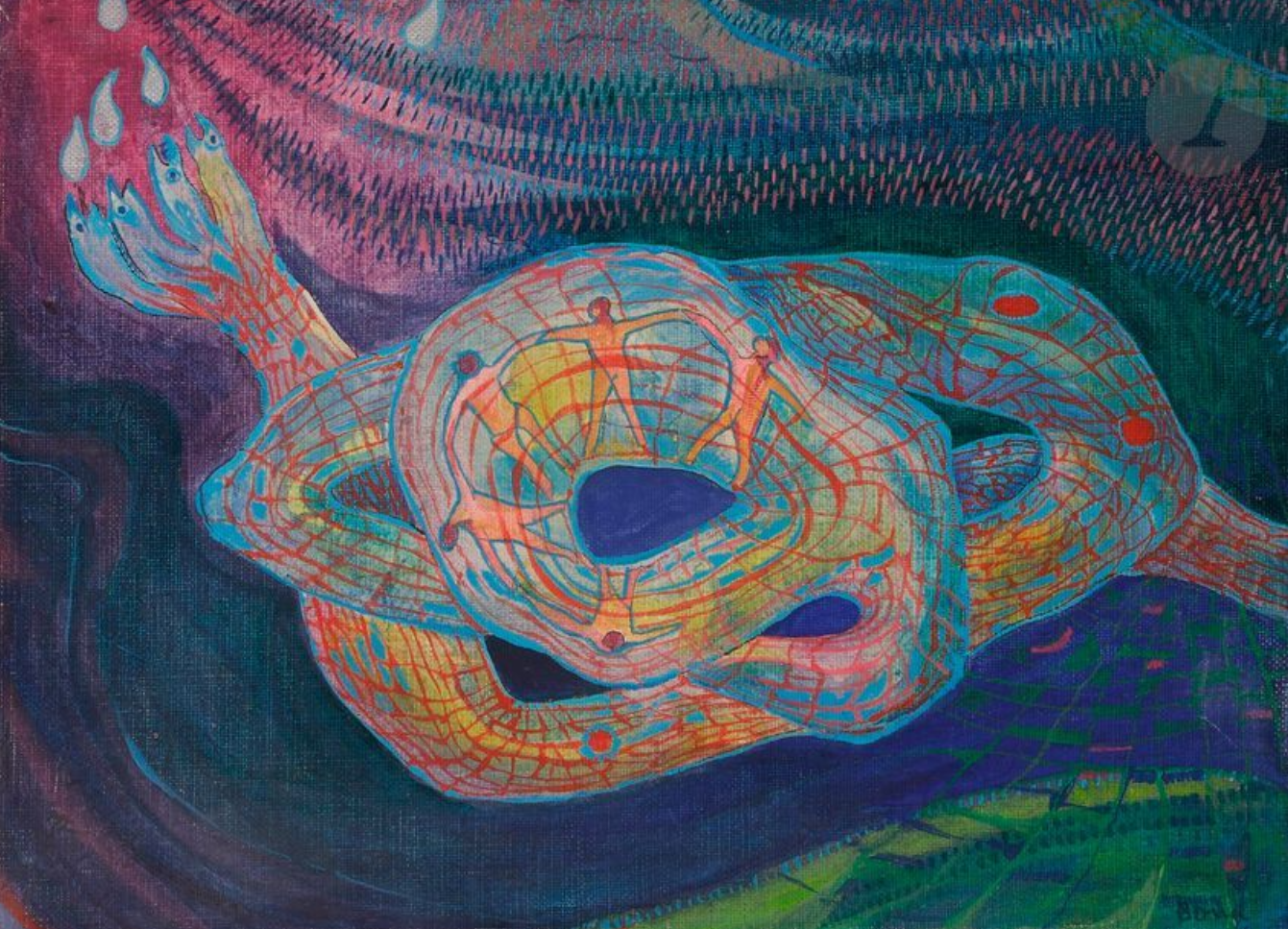
L'Univers est serpent (1968)
Bona de Mandiargues dit BONA (1926)
Italian Painter
Acrylic on Canvas

