

In the continuation of the Individuation as Initiation series, this piece explores the psychological experience of the initiand who refuses the call.
In Origins and History of Consciousness, Erich Neumann describes the uninitiated or undifferentiated state as “existence in the uroboros [which] is the symbolic self-representation of the dawn state, showing the infancy both of mankind and the child.” Moreover, he continues, “it functions as a transpersonal factor that was there as a psychic stage of being before the formation of an ego.” Those who are unable to develop a stable and flexible ego can sometimes be described as having a puer or puella aeterna complex. These individuals live a provisional life, believing “if only, then,” without taking meaningful steps to attend to the demands of the first half of life.
Consider the example of a young adult who cycles through a series of grand ambitions perhaps imagining themselves as a great novelist, then a filmmaker, then a renowned musician. Each pursuit begins with intense enthusiasm but is eventually abandoned before being brought to fruition. As debts mount and self-sufficiency remains elusive, this individual may continue to rely on parental support, both financially and emotionally.
There can be a resistance to ordinary employment, perceived as a betrayal of one’s imagined identity or creative destiny. Instead, energy is invested in the realm of possibility and fantasy, sometimes accompanied by the use of mind-altering substances, believed to facilitate deeper insight or inspiration. Yet, in failing to ground their vision in sustained effort or tangible form, the individual remains caught in a liminal space suspended between the childlike hope of “what could be” and the adult responsibility of “what is.”
According to Jung, this nascent, childlike stage ends through the gradual growth of the personality. He writes, “the developing personality naturally veers away from such an unconscious infantile bond [and] for this reason instinct seizes on the first opportunity to replace the mother by another object.” What Jung describes as ‘veering away’ from infantile bonds is achieved through the rites of separation.
In the next section, Severance and the Soul’s Call: The Painful Beginning of Individuation, we’ll explore the rites of separation in the process of individuation.

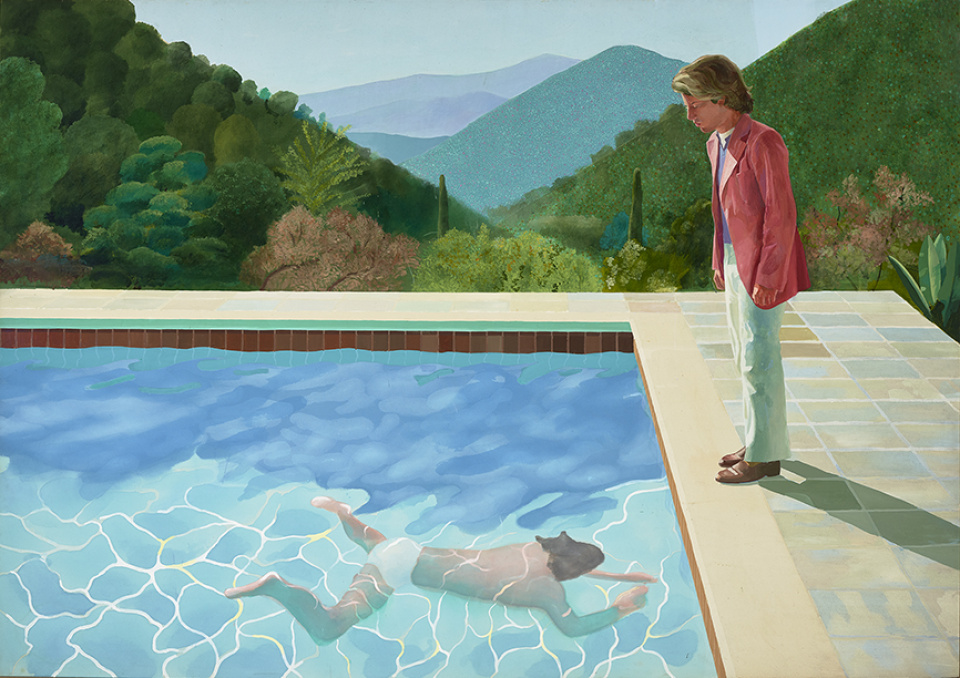
Portrait of an Artist (Pool with Two Figures) (1972)
David Hockney (1937)
English Painter
Acrylic on Canvas

