

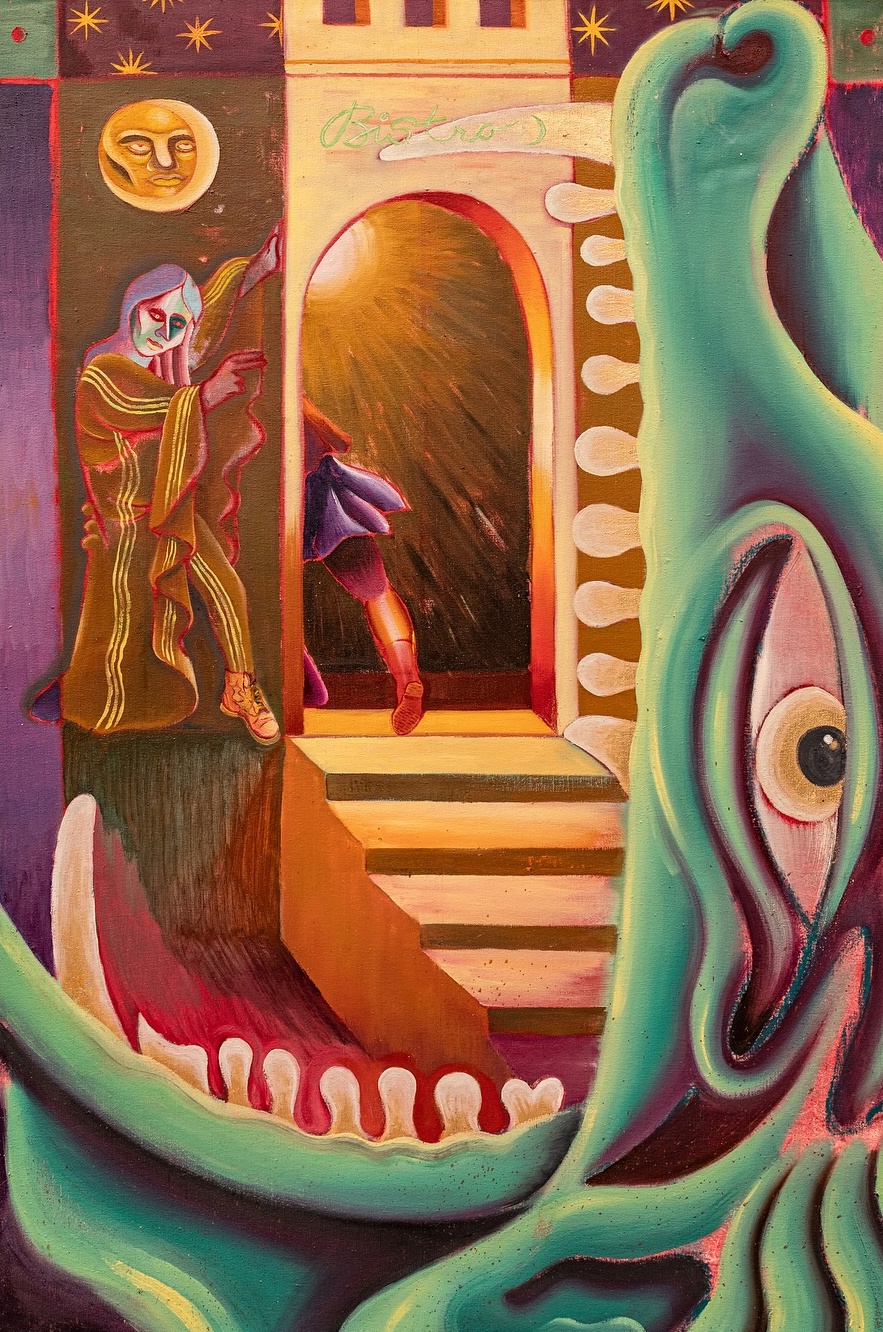
As we continue to explore Individuation as Initiation, following The Uninitiated: Before the Birth of Ego article that explores the archetypal patterns that manifest when one refuses the call to individuation, this piece is details the wounding one experiences when separating from the world parents.
Individuation truly begins, according to Jungian analyst Marie-Louise von Franz, “with a wounding of the personality and the suffering that accompanies it. This initial shock amounts to a sort of ‘call.’” This wounding and suffering has often been demonstrated in various initiation rites throughout the world. During the rites of separation the male initiand experiences a purposeful break from the community and particularly their mother. Van Gennep writes, “sometimes the novice’s link with his mother endures for some time, but a moment always comes when, apparently by a violent action, he is finally separated from his mother.” In many cases this violent action is represented by ritual death, as Jungian author Esther Harding describes,
By this he dies so far as the personal mother is concerned, and is thus released from his childish dependence on her, and is reborn as child of the universal mother, who is earth mother, the mother of his physical body, and becomes by this act the mother of his spirit, for she is also the heavenly mother.
This break from the personal mother allows the burgeoning consciousness of the initiand to be expressed. No longer held in an uroboric stasis the initiand begins to develop an ego in relation to the unconscious, as opposed to being subsumed by it.
For females, the experience of the unconscious is not a confrontation, per se, but instead has been described as a descent. In Women’s Mysteries: Ancient and Modern, Esther Harding explains,
The women do not go into seclusion once only at their initiation, but they must go apart for a few days every month and remain alone, in close touch with that instinctual force which dominates them from within, from the depths of their own physical nature.
In Descent to the Goddess: A Way of Initiation for Women, Sylvia Brinton Perera describes this as women’s many ‘descents.’ She writes,
[These experiences are] introversions in the service to life to scoop up more of what has been held unconscious by the Self in the underworld, until we are strong enough for the journey and willing to sacrifice libido for its release. The hardest descents are those to the primitive, uroboric depths where we suffer what feels like total dismemberment.
Female initiations, then, are not limited to a single incident or confrontation with the unconscious, but a continuous embodied exchange. This delineates the relationship each gender has with the unconscious and the forces of nature. Within boy’s ceremonies, there is a heroic escape or break from nature. The very opposite is expected of girls, as they are meant to become closer to their bodies, its rhythms, and nature as a result. However, significantly, both boys and girls experience a transition away from the childlike dependence on their parents.
In the absence of formal cultural or religious initiation rites, the process of psychological separation often emerges instinctively, manifesting in unique and deeply personal ways. For some, this may take the form of a physical move, perhaps even across countries, in an unconscious attempt to break free from long-standing familial enmeshment. It is often only after such a move that the depth of the psychological bond becomes fully apparent.
In other cases, the push toward separation may be externally imposed, such as a parent establishing new boundaries, explicitly or implicitly signaling that the adult child can no longer return to a prior state of dependency. These moments whether initiated internally or prompted from the outside often catalyze intense emotional upheaval.
Some individuals are able to meet this upheaval with a degree of ego strength, allowing them to regulate the emotional impact and trust the necessity of their decision. For others, the experience can trigger feelings of abandonment, despair, or even suicidal ideation – psychic responses that mirror the symbolic “death” found in traditional male initiation rites. In both instances, the severance from psychological dependency marks a painful but essential threshold in the process of individuation.
Next, we’ll explore Shadow and Inner Opposites: Confronting the Depths of the Psyche, when the individual experiences the unknown.

Dragon Sickness (2024)
Jakub Ružinský (2003)
Slovak Painter
Oil and Goldleaf on Canvas

