

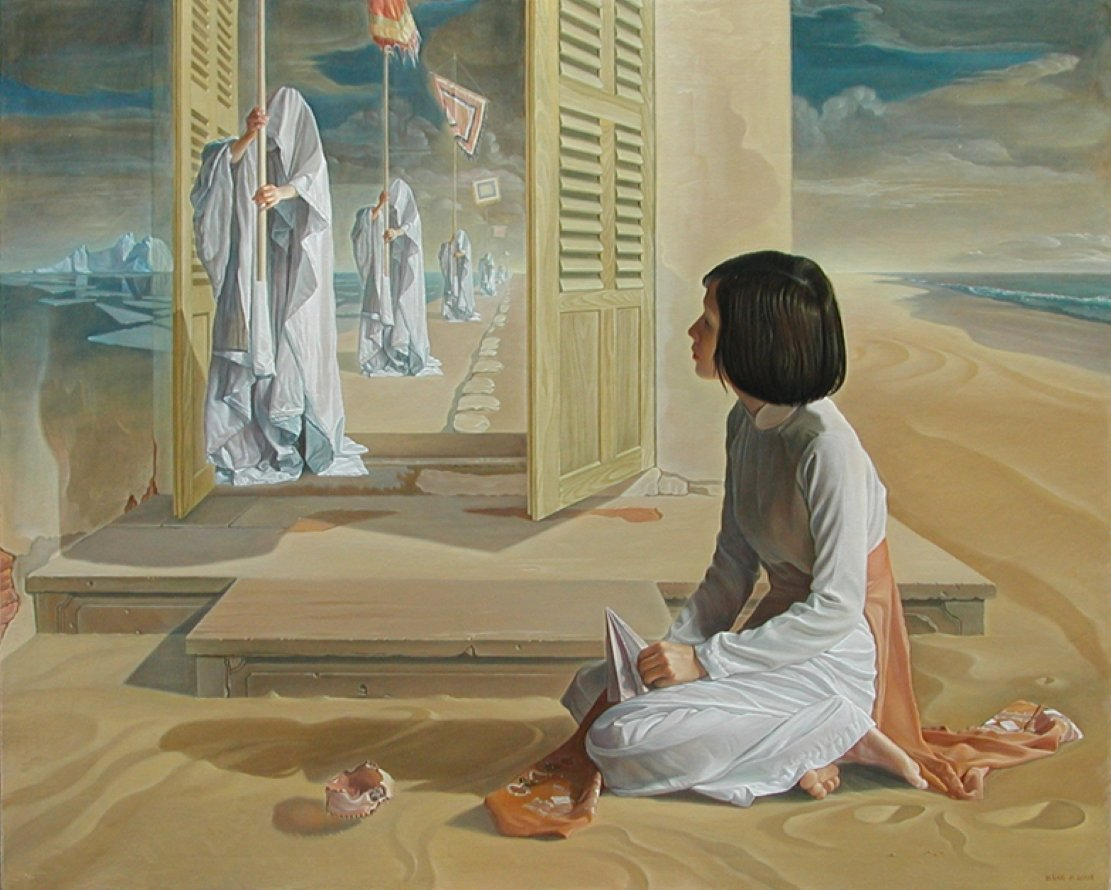
After exploring the unknowing and some of the more prominent archetypes in Shadow and Inner Opposites: Confronting the Depths of the Psyche, this piece is dedicated to the experience of liminality – between being and becoming.
In every human life, there are moments of profound change transitions where the old identity dissolves and a new one has yet to fully form. Anthropologists and depth psychologists alike have long understood these moments as liminal threshold spaces of ambiguity, disorientation, and deep transformation. From a Jungian lens, these transitions are rich with psychic mystery, and whether held by cultural ritual or by modern analytical containers, they are essential to individuation the unfolding of the true Self.
Victor Turner describes liminality as a space where the individual is “betwixt and between” no longer who they were, not yet who they are becoming. In these liminal states, traditional social markers dissolve as initiands, “have no status, property, insignia, secular clothing indicating rank or role, position in a kinship system.” This otherness creates the general sense of humility required when being “ground down to a uniform condition to be fashioned anew and endowed with additional powers to enable them to cope with their new station in life.” It is during this time the initiands experience a new education.
For Jung, these moments of transition are archetypal as they appear across cultures because they reflect universal patterns of psychic development. Traditional initiations symbolize a descent into the unconscious, often enacted through rites such as entering a cave or submersion in water. According to Jung the male initiands “receives [his father’s] instruction about these things of ‘the other side,’ so that he is put in a position to dispense with his mother’s protection.” He continues,
A simple parting from the parents is not sufficient; there must be a drastic ceremony that looks very like sacrifice to the powers which might hold the young man back. This shows us at a glance the power of the archetype: it forces the [initiand] to act against nature so that he shall not become her victim.
The ‘drastic ceremony’ Jung describes is typically experienced as a descent into the cave or diving into baptismal water, symbolically creating “a return to the womb of rebirth.” This descent is not simply symbolic, it mirrors a psychological process in which the ego is challenged by unconscious material, often experienced as chaos, fear, or disorientation. But it is through this confrontation that the ego undergoes a transformation, aided by what Jung called the transcendent function:
Rebirth symbolism simply describes the union of opposites – conscious and unconscious – by means of concretistic analogies. Underlying all rebirth symbolism is the transcendent function.
Jung defined the transcendent function as “aris[ing] from the union of conscious and unconscious contents.” Furthermore, he wrote, “it is called ‘transcendent’ because it makes the transition from one attitude to another organically possible.” From this we understand that the transcendent function is always present in rites of transition, as the ego is met with the unconscious and forms a new attitude toward both conscious and unconscious life. In other words, real change doesn’t occur by force of will alone. It arises naturally when conscious and unconscious aspects of the psyche are brought into relationship.
For women, traditional rites of transition have often focused not on confrontation but embodiment. Religious historian Mircea Eliade observed that female initiands were ritually prepared for their roles in society and in the cosmos, writing, “tutoresses instruct [initiands] in the secrets of sexuality and fertility.” He continues,
The girl is ritually prepared to assume her specific mode of being, that is, to become a creatress, and at the same time is taught her responsibilities in society and in the cosmos, responsibilities which… are always religious in nature.
In this way, the girls develop a relationship with the archetypal mother, whom Neumann describes as dual sided, both “devouring, destructive… and the force of instinct, and “fullness and abundance; the dispenser of life and happiness.” He continues, “she is mankind’s instinctive experience of the world’s depth and beauty, of the goodness and graciousness of Mother Nature who daily fulfills the promise of redemption and resurrection, of new life and new birth.” It is through this relationship with the archetypal mother that during the rites of transition girls embody the transcendent function rather than experiencing it externally as a confrontation. The mystery unfolds from within, through the body, through fertility, creation, and intuition.
In traditional cultures, these rites of passage were embedded in the collective fabric as elders guided initiands through sacred rituals that contained and gave meaning to their liminal experiences. But in modern Western societies, these structures have largely vanished. As a result, individuals are often left to navigate profound transitions alone, without a symbolic container. This is where Jungian analysis enters as a modern rite of passage. The analytic relationship becomes a symbolic container in which the ego encounters the unconscious. Analyst and analysand together participate in a ritual of deep listening and symbolic exploration, often facilitated by dreams, active imagination, and archetypal imagery.
In the last of the series, Integration and the Return: Individuation in the World, will follow the patterns of homecoming, and discuss what it is like to return from the dark night of the soul.

The Threshold (2003)
Nguyen Dinh Dang (1958)
Vietnamese - Japanese Painter
Oil on Canvas

