

Beginning the Conversation: Dreams as Unconscious Guidance
In the quiet of the night, when the rational mind sleeps, dreams arise strange, symbolic, and sometimes unsettling. But what are they really saying?
For Carl Jung, dreams are not mere ephemera or the by-products of neural firings. They are meaningful, spontaneous expressions of the unconscious; guides that could point us back to our true nature when conscious life had gone off course.
Dreams are impartial, spontaneous products of the unconscious psyche, outside the control of the will. They are pure nature… fitted, as nothing else is, to give us back an attitude that accords with our basic human nature. — C.G. Jung
To analyze a dream is not to decode a secret message, but to enter a conversation with the unconscious. And as this conversation deepens, we find that different thinkers have offered distinct ways of listening: from Jung’s structural and symbolic method, to Mary Ann Mattoon’s clear interpretive steps, to James Hillman’s imaginal, poetic immersion in the dream world. What follows is a layered approach to dream work, drawing on the wisdom of all three.
Laying the Groundwork: Context Is Everything
When we take up an obscure dream, our first task is not to understand and interpret, but to establish the context with minute care. — C.G. Jung
Every dream is rooted in the dreamer’s lived experience. Before analysis, we ask:
What happened the day before the dream?
What is the emotional landscape of the dreamer’s life?
What current challenges or inner conflicts are active?
Mary Ann Mattoon emphasizes this step as foundational. She encourages mapping the dream’s narrative structure, treating it as a dramatic arc with clear stages: exposition (setting), peripeteia (development), crisis (impasse), and lysis (resolution or catastrophe). Her method begins by stating the dream clearly and fully, before any attempt at interpretation.
Understanding context prevents projection and anchors the dream in the dreamer’s reality.
Balancing the Psyche: Dreams as Compensation
The general function of dreams is to try to restore our psychological balance by producing dream material that re-establishes, in a subtle way, the total psychic equilibrium. — C.G. Jung
Jung believed dreams serve a compensatory function, offering material that challenges or balances conscious attitudes.
If someone is rigidly rational, their dreams may be chaotic or emotional.
If someone feels powerless, a dream may depict them in control.
These images are not random; they respond to psychic imbalance.
To work with this function, we ask:
What dominant attitude exists in waking life?
What might the dream be correcting, compensating, or warning about?
This is central to Jungian interpretation, and Mattoon echoes it by linking the dream to both the immediate situation and the long-term arc of the dreamer’s life.
Circling the Image: Associations and Amplifications
There is no stereotyped explanation for dream symbols… words often have a totally different setting for other people than for ourselves. — C.G. Jung
Dream images must first be approached through personal associations:
What does this image remind you of?
What feelings, memories, or thoughts arise?
From there, we can move into amplifications, which include archetypal patterns, mythological parallels, or cultural references. Mattoon emphasizes organizing these associations into themes, linking them to both the personal and collective unconscious.
Yet Hillman warns against rushing to interpret. He urges us to stay with the image:
The moment you’ve defined the snake, interpreted it, you’ve lost the snake… The task of analysis is to keep the snake there. — James Hillman
Where Jung and Mattoon seek meaning and structure, Hillman calls us to phenomenological immersion – to describe, feel, and explore the dream image on its own terms.
Who Speaks in the Dream? Characters and Images as Psyche
In Jungian analysis, the characters in the dream are often considered parts of the dreamer’s own psyche. A teacher may represent the inner guide. A pursuer may embody repressed fear or desire.
Hillman offers a contrasting view. He prefers to preserve the autonomy of dream figures, resisting psychological reduction. Instead of saying “this character is a part of me,” we might ask: “Who is this figure, on its own terms?” In this way, we can begin to understand these characters as autonomous rather than treating them as a reductive image only present to solve our problems.
Following the Thread: The Power of Dream Series
One dream rarely gives the whole picture. Mattoon, echoing Jung, reminds us that dreams form series. Patterns, symbols, or characters often repeat across time, revealing deeper meaning as they evolve.
Sometimes, a dream series is identified by the repetition of a dream. More often, a specific motif in a series of dreams over a period of time. — Mary Ann Mattoon
Mattoon attributed dream series to either a dreamer’s fragmented dreams attempting to piece together a complete picture, or a life transition that was unfolding over time. A single dream may be ambiguous or contradictory. But seen in the context of others, a coherent psychic narrative begins to emerge.
Living the Image: Hillman’s Dream Work
Hillman’s most significant contribution is his call to befriend the dream, not to solve or interpret it, but to stay in relationship with it.
Dreams tell us where we are, not what to do. — James Hillman
Rather than asking what the dream means, he asks us to experience it more deeply.
Practical steps:
Choose a vivid image from the dream.
Describe it in full detail: colors, sensations, temperature, movement, emotion.
Let the image speak in its own symbolic or emotional language.
Don’t translate it… imagine it.
This is not interpretation, it is image work, grounded in lived experience.
Letting the Dream Speak: Holding the Mystery
Do anything you like, only don’t try to understand! — C.G. Jung
Dreams are not logical arguments. They are living expressions of the soul, which are often paradoxical, irrational, or disturbing. Jung reminds us that certainty is not the goal. The point is dialogue, reflection, and a willingness to be transformed by the process. We hold meaning lightly. We let the dream work on us over time. And gradually, something shifts, not because we “figured it out,” but because we listened deeply.
Conclusion: Three Voices, One Invitation
Dream analysis is not about arriving at answers, but entering into mystery. For Jung, it was a path to wholeness. For Mattoon, a methodical unfolding of inner story. For Hillman, a poetic journey into the underworld of the soul. Each approach offers a unique gift. Together, they invite us into deeper relationship, not just with our dreams, but with ourselves.

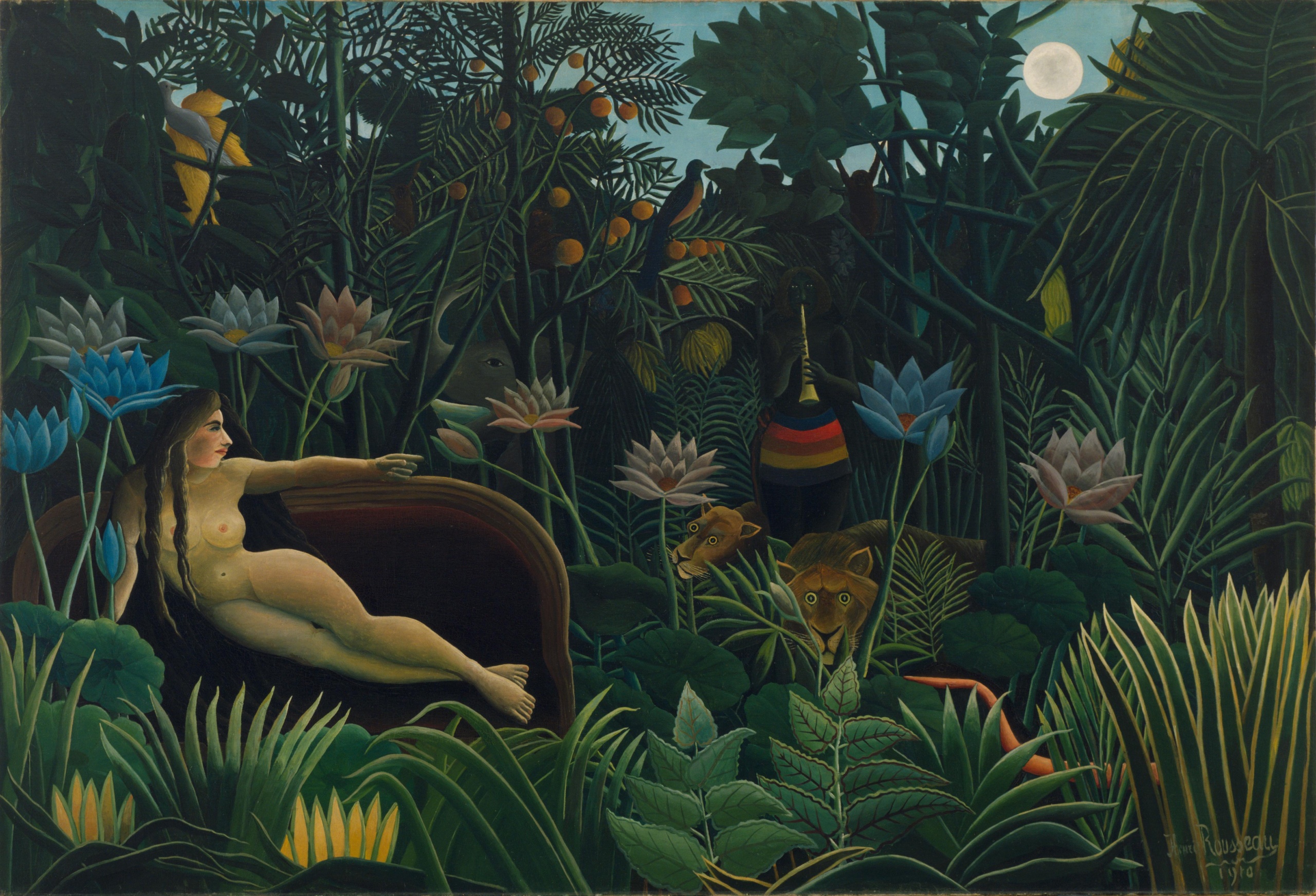
Le Rêve (1910)
Henri Rousseau (1844)
French Painter
Oil on Canvas

