

In this concluding piece of the series Individuation as Initiation, we follow the journey of the initiand who must return home, changed.
Following the rites of transition, the rites of incorporation mark the final phase of the initiatory journey. From a Jungian point of view, we would call this integration. In this stage, the initiand departs from the sacred, liminal space and returns to everyday life, but profoundly changed. As Van Gennep describes, “as a result of this passage through the sacred world, the initiand retains a special magico-religious quality.” The transformative experience leaves an indelible imprint on the individual, who must now be reintroduced to the community as someone altered, renewed, matured, or made whole.
Erich Neumann emphasizes that true initiation is not only about personal insight but also about social integration: “Being initiated and being grown up mean being a responsible member of the collective, for from now on the suprapersonal significance of the ego and the individual is built into the culture of the collective and its canon.” Transformation is not an escape from society but a reintegration into it with new responsibility, perspective, and depth.
This understanding is central to Jung’s conception of individuation. Contrary to interpretations that see individuation as solitary or self-contained, Jung clarifies that the individuated person becomes more, not less, capable of meaningful collective participation:
As the individual is not just a single, separate being, but by his very existence presupposes a collective relationship, it follows that the process of individuation must lead to more intense and broader collective relationships and not to isolation.
In this view, the culmination of inner work is not withdrawal, but return. The individual who has encountered and integrated unconscious contents (shadow, anima, animus, and ultimately the Self) is now capable of inhabiting life in the world more authentically and responsibly. Jung writes elsewhere:
Wholeness is not achieved by cutting off a portion of one’s being, but by integration of the contraries.
Thus, wholeness achieved through individuation finds its expression not in separation from others, but in deeper engagement with community, with culture, and with the human condition itself.
The experience of reentering collective life after transformation also speaks to a broader archetypal pattern echoed in myth, ritual, and depth psychology. The initiand, like the mythic hero, must return from the underworld bearing the fruits of the inner journey. Through the transformative journey, the individual becomes a vessel for integration, not only internally, but within the fractured social world. In this way, the process of individuation is not an end in itself, but a preparation to serve something greater than the self.
The Roman playwright Terence once wrote, “I am human, and nothing human is alien to me.” This sentiment echoes the ethical obligation implicit in individuation: to recognize oneself not apart from, but within, the shared fabric of human experience.
Initiation rites, whether tribal, religious, or psychological, have long served as containers for transformation. They trace a timeless pattern of death and renewal, mirroring the inner development of the psyche. In Jungian terms, this pattern is synonymous with the process of individuation: the maturation of the personality through engagement with the unconscious and integration of its contents. Where traditional cultures provided ritual containers for this transformation, modern individuals must often navigate the process more privately, or symbolically. Jung makes a critical distinction between unconscious and conscious individuation:
The difference between the ‘natural’ individuation process, which runs its course unconsciously, and the one that is consciously realized is tremendous. In the first case, consciousness nowhere intervenes; the end remains as dark as the beginning. In the second case, so much darkness comes to light that the personality is permeated with light and consciousness necessarily gains in scope and insight. The encounter between conscious and unconscious has to ensure that the light that shines in the darkness is not only comprehended by the darkness, but comprehends it.
Jungian analysis can serve as a modern rite of passage. The rites of separation correspond to the breaking away from unconscious identification, facing the shadow, the anima or animus. The rites of transition involve working through inner tensions via the transcendent function, gradually orienting toward the Self. Finally, the rites of incorporation represent a return, not only to the ego, but to society as a more integrated, responsible, and whole human being. These stages, though inwardly experienced, have profound implications for how one lives in the world. Individuation, when fully realized, is not an escape from life, but a return to it transformed, and carrying the wisdom of the journey back into the world.

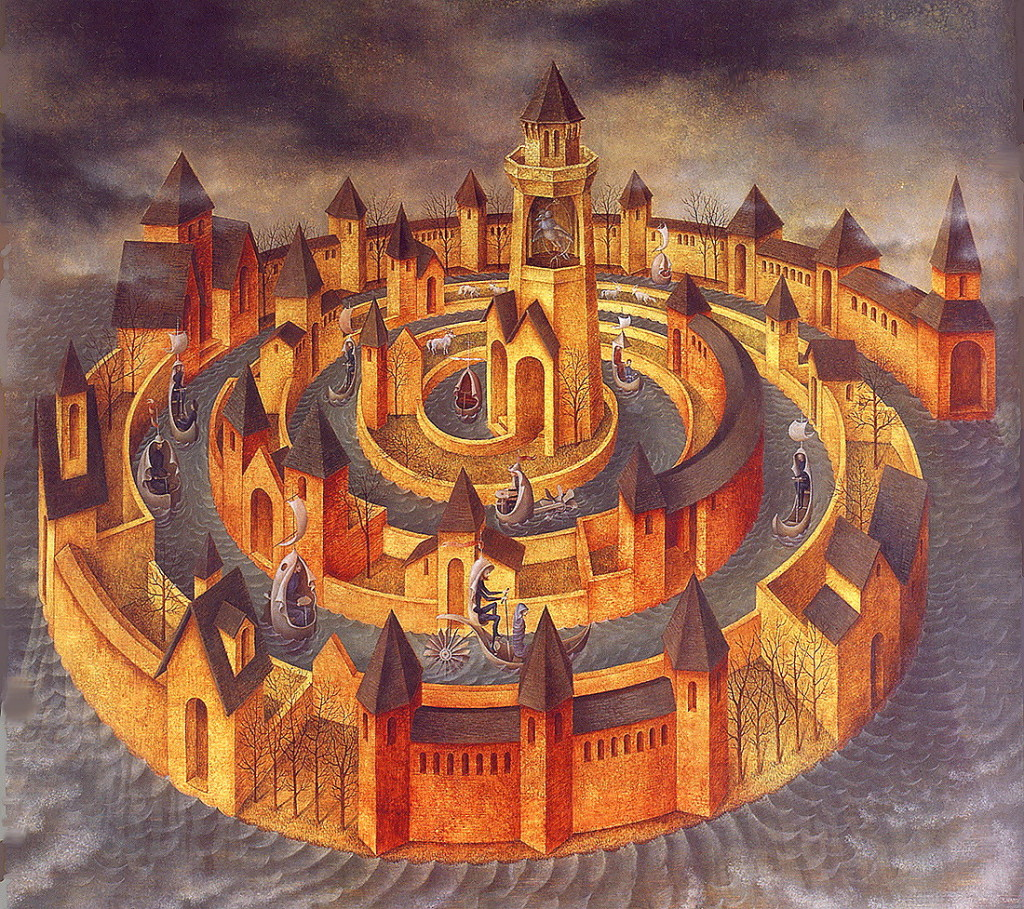
Tránsito en Espiral (1962)
Remedios Varo (1908)
Spanish - Mexican Painter
Oil on Masonite

